Wednesday, October 10, 2018

The Hazards of Hospital Care


When Hospitals Care Fails Us, Why Should We Not Blame?
Presented at A Writer's Evening, Vanni Bistro Café, Berkeley, CA, 10/9/18


The Case of Ilana Yurkiewicz's Father


Our text for today appears in the July 2018 issue of Health Affairs: 


A young doctor down at Stanford, Ilana Yurkiewicz, recounts the medical misadventures of her 68-year-old father during a two month hospitalization (not at Stanford) following his cardiac arrest. Her dad was very lucky; after a heroic resuscitation with 9 separate shocks over 20 minutes with 6 cracked ribs, he survived. An intern at the time, Ilana and her physician sister naturally responded by taking leave to be by his side kat the hospital.

Like many other doctors who have found themselves in this position, Ilana was shocked not only at being at the periphery rather than the center of medical activity, but also by the multiplicity of errors, instances of careless care, and the obvious deficiencies of organization that the hospital delivered to her father.

I'm going to review the details of this interesting case, review what Ilana thinks it should teach us, and then offer what I think it should teach us, and why we should be very disturbed at the root causes of her father's mistreatment.

Details of the Case – What Went Wrong

As she sat by her Dad's bed, she saw that “Details slipped through the cracks. Preventive measures were overlooked. Complications happened, and then they snowballed.”

On morning rounds “three days after my father's cardiac arrest, his medical team agreed that he should come off the ventilator.” By evening nothing had happened, but “the covering doctor was busy. It would have to wait until the following morning.”

Note: This is a major error in care. Just as justice delayed is justice denied, medical care delayed is often effectiveness denied. And in this case, that's exactly what happened. Because the ET tube stayed in and was irritating, he would have to be sedated overnight. The doctors on the team had written the order to allow the nurse to use her discretion in choosing the dose of the sedative.

This is another error. They assumed the nurse would be competent to make a choice. She wasn't. Ilana and her sister pleaded with the nurse to make the sedation light so that extubation could be effected the next day. But for some unknown reason the nurse elected to give the maximum dose allowed, and as a result their father was zonked out for 5 days. After his cardiac arrest his kidneys were not working well (as every clinician would expect) and it took them a long time to clear the sedative. Total time on ventilator, instead of three days – nine days! Nine days ripe for further misadventures.

Note here what is happening. There is a “medical team.” “Team” may sound like an attractive idea with two heads being better than one and someone always available who knows about the patient, but a team also means a decrease in individual responsibility, extensive needs for scheduling, coordinating, signing off and signing on, figuring out who does what, and in many cases no one really knowing the patient thoroughly. In addition, teams are composed of ICU doctors, in-patient physicians called hospitalists (doctors who work for the hospital for inpatient care), residents (doctors in training), nurses, and other non-physician personnel. Many members of the team are young and inexperienced. There is no one on the team who knows the patient before hospitalization and no one who will know him afterwards. When I hear “team,” I think: bureaucracy, with all the protection from individual responsibility that bureaucracies afford. It was a bureaucracy that missed the extubation because nobody was responsible for it, and it was bureaucracy that scheduled there to be only one on-call doctor at night, who then didn't have time to execute the orders, and it was bureaucracy that over-sedated Ilana's father because the team assigned a less qualified team member who made a bad decision without review in real time.

Back to the text: because the ET tube was in so long, Ilana's father's vocal cords were swollen (I wonder if the tube had been properly placed and maintained) and he needed a NG tube into his stomach for feeding. The resident – a doctor in training, remember – wrote the orders for tube feeding and forgot to say that they should also give him water. The “team” left the arduous task of writing the orders to the junior member and didn't check them over in real time. Because of no water, Ilana's father became thirsty, dehydrated, and delirious – a diagnosis made by Ilana, it seems. Instead of just giving him water to make up for the oversight, the hotshot ICU doc thought the delirium might be because of his kidneys' failure to clear waste products, so he had a catheter placed in his neck for dialysis – very invasive, uncomfortable, with risks – and then after a few days they found that the dialysis made no difference and it was time to pull the line out. BUT, shades of extubation, this time the delay in removal was because … it was the weekend! Can't do anything over the weekend! Because, we don't staff our hospitals fully over the weekend, because everyone knows that patients don't have the same medical needs over weekends. Hey, let's all get some R&R! Maybe the patients should go to the beach, too! Two more days of the catheter.

I'll stop the clinical course there; there were other problems but not so severe, and luckily Ilana's father went home and is even back to work. What a lucky man. And let's face it, even with service deficiencies, modern medicine is great. Modern medicine is great.

Analysis - Hers

Ilona is a smart young doctor, at Stanford via Harvard – smart enough not to stay in the field of general medicine but to have now bolted to the specialty of oncology, where her life will be more controllable – so as she writes this up, she looks for root causes of the problems, as we in medicine are taught that we should do. She assumes that her father’s case is not atypical, because she has seen so much of the same thing in her own experience, as have many others, including me. In fact, many if not most people can recount their similar stories. There is not much literature on the extent of errors (which is an interesting and perhaps indicative fact in and of itself), but we know they are extensive. For instance, perhaps 10% or more of the time doctors miss the diagnosis.

Ilana has been taught to search for root causes and not simply blame the on-call doc for not being available, the nurse for ordering stupidly, the ICU doc for missing the diagnosis, and whoever it is who shuts down the hospital on weekends. But, although she is smart and an excellent writer, she's young and not widely experienced, and not educated about systems and organizations, so her list of lessons is short and not terribly deep. She says that doctors should stop using the passive voice (such and such happened) and instead take responsibility, and appreciate that one error can then cascade, so errors should not simply be excused. Noting that over two dozen doctors participated in her father's care over two months, she says that continuity of care should be honored more, so that the doctors can better appreciate the details of the patient's course. She also notes that technology should be better applied so that, for instance, a warning should appear on the computer when too much sedation is ordered, and feeding water with NG tube placement should automatically appear on the order sheet. She notes that various hospitals are pursuing doing just this (various hospitals – what a national system, where there very few enterprise EHR companies, but where solutions have to be developed separately!)

While they are correct as far as they go, none of these suggestions is exactly earth shaking. Importantly, she does not even mention the presence of or actions by administrative leaders: supervisors, heads of service, administrators, or the agencies that give quality grades to hospitals. She seems simply to accept the existence and structure of clinical teams, and the heavy patient loads that put doctors in the position of having to make the difficult prioritization decisions that screwed her father.

My Analysis

I've been around a lot longer than Ilana, and unlike her, I'm reflexively critical and paranoid rather than complaisant and obedient in the face of large medical institutions. When they teach us not to be angry and complain, but to understand that we are all striving for the same ends, I don't believe them. I think they are trying to shut critics up and preserve their own power, money, and priorities. In other words, I'm realistic.

Are patients and large medical institutions really striving for the same ends? Patients want excellence in care, no question. So do doctors and administrators. But doctors and administrators are the ones in charge, and they want other things as well. Institutions need to teach, so they include residents and students on the clinical teams, which weigh them down and cause delays and errors. At the same time, the use of students and younger professionals save the institutions money by low or absent wages. Large medical institutions are very concerned about profit, not a patient-shared objective. They care about preserving their monopoly or oligopoly status, which actually hurts patients. So, let's not whitewash the potential conflict between the goals of patients and institutions.

Consider the large medical institution as an organization. I like to break down organizations into two types; blame organizations, where the most important goal is to escape blame and not get in trouble, and achievement organizations, where success in achieving progressive objectives is paramount. A sports analogy might be apt. Some sports franchises seek to be as profitable as possible; they keep the payroll low and win as many games as necessary to attract a crowd. By contrast, other franchises have winning as the goal, while not losing money is the constraint. With a large medical institution, one must ask, what is the goal and what is the constraint?

If excellence in care were really their top priority, they would measure it – remember the old managerial adage, you manage what you measure. But their measures of clinical excellence are very general and spotty – e.g, they look at total patient days per diagnosis. Not one thing that happened to Ilana's Dad would appear on a quality report, and the length of his hospitalization would be rationalized by risk assessments.

So what are we to make of the priorities of large medical institutions that measure profitability in exquisite detail, but measure quality of care vaguely? It is important for these institutions to avoid being cited as purveyors of bad care, and to be reputable enough to get enough patients to fill the beds. In other words, as a rule, large medical institutions seek to maximize profitability and view quality of care as their constraint.

So, don't tell me that we are all searching for the same thing, and it's simply a technical issue of how to achieve it.

To go just a little bit further down the chain of command, there are other priorities besides profit and quality. How does a situation arise where there are more patient needs than doctors available, as with night on-call and weekends? It might be a question of personnel cost, but it might also be a question of the convenience of the clinicians. Why did more than two dozen doctors treat Ilana’s father? Ilana says that the case details are missed that way, and she's right. But also importantly – and note she doesn't even mention this – does anyone ever get to know and care about the patient as a person with this merry-go-round of clinicians? Certainly, patients are not involved in scheduling. I’d say the providers schedule with the needs of their own lives the first priority.

So, when institutional officials say don't get angry, we're trying to get to the same place you are, we're trying, I call BS.

Two more points.

The medical industry also exhibits a curious discrepancy: the science of medicine is advancing rapidly, but organizational experimentation and change is slow and rare in medicine. (The invention of the hospitalist is an exception, but it seems that needed reform is now too slow.) Why is that? I mentioned earlier the bureaucratic nature of clinical teams, and the fact that patients are begging for care on the periphery of those teams. Are any serious efforts being made to restructure care so there is caring for and about the individual and not just treating the medical case? Are there any serious efforts to expedite patient demands for care on the wards? Now that primary care doctors who know and care about the patient have been kicked out of hospitals, is there anyone to speak up for them, except for the occasional physician family member, and we've seen how even doctors in the family can be ignored. I haven't heard of organizational experiments to change hospital care, and I doubt that there are many such experiments. Why isn't someone messing around with our inpatient system to get better results?

Knowing and caring about the patient as a person is not only the essence of medicine which being lost in current methods of inpatient care, it's also instrumentally important. It's much harder to put off a procedure or not review orders written by others for a patient you know and care about, as against the arrest in Room 44.

Secondly, not to beat a dead horse, but it bears repeating, a major reason for inaction is that there is no money and no glory in discovering better organizational actions. What's better for patients is not necessarily what's best for the bottom line. My friend, Colleen Kraft, currently the President of the AAP, until last year headed a program at Cincinnati Children's Hospital that successfully kept many patients out of the hospital by enhanced primary care – good for the patients, good for cost. But when the hospital board got wind of the program’s success, they took the only logical step a board could take. They killed the program because it wasn’t serving their prime objective, which was to fill up the hospital beds with paying patients.

Common goals my foot!

I'd like to discuss various ways we could think of to introduce the strengths of primary care onto the hospital wards, but I'm already over my word limit. So, let me leave you with this well thought out conclusion:

IF YOU TELL ME THAT INSTITUTIONS ARE DOING EVERYTHING THEY CAN TO PRODUCE EXCELLENCE OF CARE WITH AS FEW MISTAKES AS POSSIBLE, THAT IT IS JUST TECHNICALLY VERY DIFFICULT TO COORDINATE EVERYTHING, WHILE SOME OF THIS MAY BE TRUE, BASICALLY, IT ISN'T, AND I CALL BS!

Budd Shenkin

Thursday, September 20, 2018

A Letter to the Warriors


Thank you so much for the great job you have done with the Warriors. I have been a fan of the Warriors since about 1949, since I grew up in West Philadelphia and loved basketball early. I had season tickets all during the Don Nelson era, starting in 1988, and in the last decade have attended regularly.

I have seen the game evolve in many ways, most good. But one thing I have noticed is not about the game itself, but rather the way the country has evolved in its idea of patriotism. I am as patriotic as the next guy, but patriotism means many things. Specifically, when the flag is rolled out at the beginning of the game, I find it disconcerting that it is almost always in a military context. While support for military troops is important, it is also important to show support and gratitude for those who serve us in other ways.

I would propose that you consider this: when the flag is rolled out, could you have “honor guards” consisting of others rather than simply military people? What about teachers being out there with the flag, and the crowd asked to show support from them, who give so much? What about first responders? What about pediatricians, for that matter? Hell, I wouldn't object to VC's! Everyone contributes to America, and we should be willing to share the gratitude widely.

Again, thanks so much for your own very worthy contributions to the game of basketball and the people of the Bay Area. I would hope that you would see this suggestion as consistent with who the Warriors are, and what the NBA is, as contrasted to other, perhaps less mindful sports.


Sincerely yours,


Budd N. Shenkin, MD

Wednesday, September 19, 2018

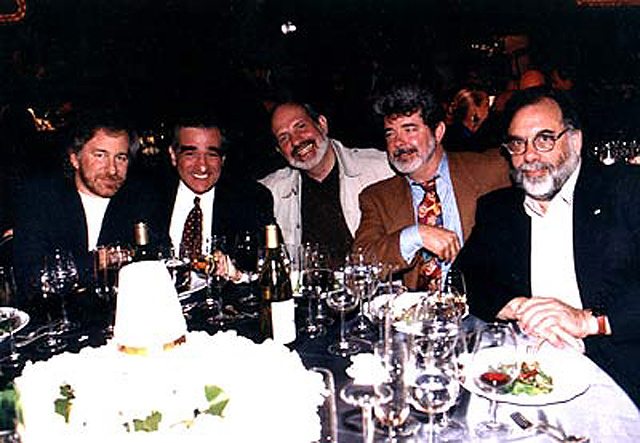
Stuart and Brian


https://www.thecinemaholic.com/wp-content/uploads/2016/05/spielberg-scorsese-depalma-lucas-and-coppola.jpg

There it was on my Twitter feed – what a word, “feed”!, like when little Lola looks at her grandfather and with exquisite economy of words, opens her mouth and points her finger down the gorge and says, “feed!” – a picture from 1994, of Spielberg, Scorsese, Coppola, Lucas, and Brian DePalma, all of whom had ascended to movie immortality in the 70's, drinking after dinner at Lucas's 50th, big smiles, white tablecloth, hair still dark although some beards white, the immortals. What would they do next? We know, because it's now the 20-teens, and the future has been written, and we know that they never really descended, they just moved on and in Spielberg's case even further up, and it's still hard to say they weren't the best.

But what I know and others don't, probably, even Brian himself, is what happened before, and where another fork in the road ended up. Because I am just one year younger than he is and for four years we went to the same school, Friends Central School, just outside of Philadelphia, a Quaker school that still had some Quakers but they were a minority in their own school. We were Jews, of course, (not Brian, but the rest of us) from West Philadelphia, I was on 47th just off of Osage, Bob was at 46th between Osage and Pine, and Stuart was on Osage between 46th and 47th. Our parents knew each other, so we knew each other, and somehow all three families, and Billy Loesher's family from 46th and Osage, too, all had found FCS and had abandoned the inadequate local Henry C. Lea Elementary School.

We commuted together in a dark green station wagon supplied by the school, with a driver who came by and picked us up at our houses and took us the 45 minutes or so over city streets, out Walnut to 63rd and then North past J. McCullough, Undertaker and various other landmarks that we imbibed daily as we drank in the parts of the city we would never see otherwise – well, maybe Bob would, but I wouldn't – and it was Bob (then called Robert), the four of us Shenkin's, and Stuart Egnal. And a few others. I must be misremembering, because how could such a crew fit into that dark green station wagon, I wonder?

Stuart was a year ahead of me, and I was a year ahead of Bob. Stuart was bigger than I was by a little, his father and mother being a little bit bigger than my parents. Mike Egnal was tall and lanky, a lawyer, and in the summer he ruled a public tennis court down in Beach Haven, NJ, saying who would play when. My father envied his dominance somewhat, I think, as he did the social savoir faire of lawyers who, when a situation arose, somehow knew how to take charge, while my father's dominance was confined to the hospital, where his prestige as a neurosurgeon conferred the rights that Mike seemed just to assume on the tennis court. Mike's wife, Stuart's mother Sylvia, had a similar physique to Mike's, above average height, wide shoulders, and more respectful and non-intrusive than most of the Jewish women I knew and would come to know. I came to understand that she had eyes on me for her daughter Betty Ellen, a couple of years older than me and later on at Radcliffe when I got to Harvard, but I didn't see her there, although I think Sylvia wanted me to look her up and Betty was receptive (maybe obediently) but she had her own life and I think she wound up in London, like my youngest sister, Emily, and I think she was in art history. I'm not completely sure she was in art history, but I think she was, but I'm positive she wound up in London. Come to think of it, I think Sylvia painted.

When you finished 6th grade at FCS you moved across the roundabout at the end of the driveway to the Upper School, which was to my eyes a Victorian sort of building, with towers, wood floors, and narrow or medium sized hallways, and classrooms with warm lights and windows that looked out on trees and greenery that you wouldn't see around West Philadelphia. Sunlight and green trees and grass and bushes and little swales filled me up with something, a feeling of being saved, a feeling of luck, a feeling of being taken care of by my parents, a feeling of luck, and a feeling of being somehow out of their element and therefore a little out of mine, too, but accepted by these Quaker step-parents who were patient with me, even with my high-spirits, and some even liked me, like Mr. Burgess. Everyone had to play sports, and even if my parents weren't as big as his, and even if I was a little smaller than he was, I still thought, I knew, that I was a better athlete than Stuart. He was OK, but I was better. And even if Betty Ellen was smart, which I didn't know at the time, I knew that Stuart wasn't that smart. How do these genes sort themselves out, I wonder? It's a puzzle, even if we know 99.9% of our genes are identical, that .1% is pretty powerful, and I don't think it's just environment. Or maybe it's just the differences we concentrate on. I don't know.

Stuart hung around with Brian; they were in 8th grade when I was in 7th in the Upper School, just getting used to the Victorian architecture instead of the less elevated functional architecture of the Lower School, where Miss Reagan would still take a half-hour now and then to read a book to us all in class – can you get that, reading a book collectively to 6th graders? I'm sure that doesn't happen anymore – and I remember she read to us about Chaim Solomon, who was depicted as the brains behind the financier Robert Morris, who funded the American Revolution. Was there a reason they picked that book, were they nipping at anti-Semitism in a school populated by a significant number of suburban gentiles who chose private school over the quite acceptable suburban public schools, the gentrified business people of the Main Line? Or in the case of Brian De Palma, the son of business but of a physician my father knew, whom my father thought he outranked even though he was Jewish, because after all my Dad was a neurosurgeon, and one who had excelled as a resident at Penn, indeed, had been legendary (if abrasive). Tony De Palma was an orthopedist at Jefferson, and when Brian's name came up, my Dad recalled that yes, he knew his father. Doctors tended all to know one another in those days, I think, there were so many fewer, and orthopods and neurosurgeons were sometimes rivals.

As I carefully roamed the narrow hallways and back stairs with windows to the natural world of the Upper School, since I was in 7th grade and then 8th grade – my last year at FCS, since we moved to Lower Merion over the summer and I switched to Ardmore Junior High and then Lower Merion High – I was conscious of myself the way an early teen is, for the first time, although I didn't notice that I had grown a new part of my brain that seemed to observe me. Those are the years of your life that you turn into different streets of life, not necessarily mean streets, especially in the suburbs, when girls stop being just an annoyance, when you can do the harder math pretty easily, when your shots start falling into the basket more readily. These are the years that a parent wants you to be around good influences, caring people, and nice kids, to be able to see trees and bushes and the sky around you and to smell the spring and trample on the turf. Those are the years when you find out more about what you're good at and what you like, and where you continue to find out where you stack up.

I was lucky. I was good at things. I was good at math and science and reasoning and I read on my own, although I don't think I was much of a writer. And I was the best basketball player in my grade and I played shortstop and I hit well, and I even was good at football where I ran the ball and intercepted well on defense and could field a punt surely. Stuart was a year ahead, with Brian, and even though his father was a lawyer and his mother intelligent and his sister would be going to Radcliffe, Stuart just wasn't that smart. I guess we were rivals, but I'm competitive, so I guess we competed, at least in my mind, I guess predominantly in my mind, reflecting my father's mind which always seemed to have a tennis ranking system in place, with intelligence as traditionally conceived the means of ranking, and with intelligence mediated by grades. I got good grades for achievement and lesser grades for behavior. I imagine the parents talked about their kids' grades and struggles and achievements, and compared and competed and worried (what anguish that could be), and hoped. Hoped the way Coppola's Brando wanted Michael to pass into the ranks of the pezzonovante, a Senator or Governor or something like Kennedy, I would think. Years later, when I decided to be a pediatrician and not a hotshot academic or something in government, my mother observed that I had chosen “a little life.” My Mom had a way with the cutting bon mot, concise, hurtful, she thought realistic. I don't think Sylvia indulged in that, but who knows outside the family?

My Mom sat me down one day and told me I was smart enough that I could be anything I wanted, except maybe a mechanic or someone who put things together. I objected that I could be a mechanic if I wanted, and her desired positive insight and support turned into a stalemate. I guess she wanted me to put an eye on the prize as I wandered, and it was true, I wasn't good at choosing, never was, and not helped by her who kept choosing for me, maybe trying to help, but maybe just impatient with me, when she chose rapidly and decisively and I could hardly figure out later on which brand of shaving cream to settle on down at Ricklin's Hardware in Narberth. They say that sometimes in a family temperaments are mismatched, and that's what I've settled on for my diagnosis.

I wonder what Sylvia would say to Stuart. His default would be to be a lawyer like Mike, and like his younger brother Johnny would be, but Stuart wouldn't have been up to it. He was spirited, though. I remember walking through the Upper School hallway and coming upon Stuart and Brian, just outside the door to one of the classrooms and beside an exit to the second floor stairs, with driveway below and trees and sloping field out the back, towards where now the Lankenau Hospital has filled in the entire landscape, which we saw arising just at that time with orange girders looming above the football field, and there they were, the two of them, spirited. They had bent down in half deep knee bends so their thighs stuck out in front of them, and in unison they were clapping their hands together then hitting their thighs and doing a drumming beat and they were chanting, I remember so clearly, something I had never heard before, “It's a treat to beat your meat on the Mississippi mud, it's a treat to beat your meat on the Mississippi mud,” with naughty smiles as their classmates walked out of the room and onto another class. Their voices had changed and the chant was low-pitched. This is my memory of them, two friends with a common spirit.

The last time I saw Stuart was outside the American Express office in Paris, as we picked up mail in the summer of 1962 on vacation, just running into each other. I was with my brother, about to pick up a blue Volkswagen bug and drive it down to Greece and back to Amsterdam and send it home so Bobby could drive it to the University of Michigan where he would be a sophomore. Stuart was there with other friends, and he told us with excitement and expectation and a little bit of wonder that he was there and doing that, that they were going to Spain. Spain was ruled by Franco, and cautious as I was, inherited from my parents' McCarthy days experience, I wouldn't for a minute think of going there. We took off for Italy instead, untutored in the world, driving a lot, and getting homesick maybe, meeting some girls, not knowing how to have too good a time, maybe, I'm not sure. But Stuart was headed to Spain.

And Stuart had decided to be an artist. An artist? Who decided to be an artist? Who knew he could draw? Could he draw, or paint? Who knew? Who did that? Who didn't become a doctor or a lawyer? The way Russians and Indians become engineers. Stuart an artist? But yeah, Sylvia painted, I'm sure she did.

I actually still have a painting that Stuart did, I think, maybe somewhere, or maybe just in my mind. It was a pottery vase, yellow, with a plain medium blue background, maybe it was OK, or good, or who knows, it wasn't Picasso, but it sure wasn't something that I could have done, either. A 36 inch tall picture, maybe. But after that meeting at the Paris American Express, the next time I saw the Egnal family was a few years later, when they were supposed to be sitting shiva after Stuart died of thyroid cancer. He must have been in his twenties, and my parents pushed me in through the front door of their house without knocking, because as far as they knew that's what the tradition was, and because my mother said “Stuart was Buddy's friend,” and because I always seemed to be pushed forward, and we saw the Egnal family à table, just the four of them then, and they looked up surprisedly and didn't know what to make of the intrusion at first, and then Sylvia looked up from her end of the table that was facing me, and said, “Buddy!” and came over and was emotional and welcoming and I wondered if I had been closer to them and to Stuart than I knew. Johnny had visited Stuart everyday he was in the hospital, out at Temple I think I remember, and been a good brother to the end, somewhat to my wonder because I just remembered him as a kind of clutzy younger brother. What does one say when a child dies, even if he had struggled there were still hopes and love and what do you do? You just lean on yourself and others and even if you're not religious you lean a bit on God, I think, and hope there's something in the world or beyond it, something somewhere.

But there was Brian, so much like Stuart in my memory, with Marty and George and Francis and Stephen – but no Stuart, and of course even absent the cancer, there would have been no Stuart in that picture, of course. It's only in my mind.

The last time I saw Sylvia was at someone's funeral, maybe my Dad's, I don't know. She was still living at their house on Osage, by herself, Mike having died many years ago after years of debility, and she seemed a little smaller but still somewhat rangy, still driving herself, at the age of 96. Amazed at herself. I wonder if she liked Brian's pictures? I wonder if she saw them.

Budd Shenkin

Thursday, August 23, 2018

The Climax Approaches

Yes, the commentators can't resist saying that Manafort's conviction - one vote short of guilty on all counts - and Cohen's plea and accusation do not mark the end, nor the beginning of the end, but perhaps the end of the beginning.  They lose no chance to repeat someone else's bon mot.  They reflect on how long Watergate took to come apart, or to come together, whichever way you look at it. 

But I'll stick with my analysis of last month when I said, comparing Trump to a stock, that the tax bill was probably the high, and the lows now lie ahead.  I'd say that yes, Watergate took a few years, but then Nixon was smarter than Trump by a lot, and the path to impeachment was not well known then.  Watergate has lit the way, though, and now we can see our way forward more clearly.  We'll go faster this time.

So I'd say the end has begun and things will travel a lot faster than people think.   Why are the GOP leaders so quiet?  Don't they see the end so clearly?  Don't they understand how silly they look?  What I'd say is this: I think they see it very clearly indeed; they just want to get in their last licks.  The GOP objectives have been destroy ACA (in process), get a big tax bill for the rich (done), and fill SCOTUS with young conservatives (one down, one to go). 

So,that's their motivation for silence and Trump-toleration at this point.  As soon as Kavanaugh is decided, one way or the other, they won't have much more on their agenda, and they will be able to go back to electoral politics.  At that point the dam will break, and as they open up Donald will find himself without a life raft.  What will they care?

The Kavanaugh affair is then the final act of the Trump Crime Family Administration.  But, even though we might picture that as a relief, it really won't be.  It's hard to predict what will happen, but the bitter fight will go on, the GOP will continue to be enemy rather than opponent, they will fatuously claim that this is the time for "unity rather than divisiveness," and the Dems will be tempted to hear that siren song; while some will say we need justice, others will say that will be too divisive, etc. etc.

As for me, I will count myself as being among those who will take pleasure in every orange jump suit and ask for more, until they get Ivanka and Jared along with the easy mark, Donny Junior, and the other merry band of miscreants, the stupid evils of the Trump Crime Family Administration.  Personally, I'd like to see justice meted out à la Nuremberg, and I'd like to see the evil-doers in the dock à la Goering and Joey Goebbels.  But that's unlikely, and I guess I'll have to be satisfied with the jump suits.

What crooks they are, with every fiber and down to every pore!  Crooked beyond crooked!  Carpe diem, be here now, watch them get locked up.  I'm just waiting for Act V.

Budd Shenkin

Wednesday, August 8, 2018

The Death of Stalin


I was born in 1941, just three weeks before Pearl Harbor, 12 years after the Depression started, and 24 years after the October Revolution. My parents were first generation Jewish-Americans in Philadelphia, my father a doctor with, apparently, a history in his family of radicalism on his father's side, at least that's what I came to believe when we decided that I would not be Bar-Mitzvahed, a distinction that had also eluded my father. They were avowed Jews, yes, decidedly, but also not observant, unless eating together on Jewish holidays counts as being observant. Someone in his family, my father said, thought that religions led to war. Maybe they were European radicals, I really don't know. But I also suspected that paying lots of money for a party for induction into something he didn't believe in didn't make sense to them. “Them,” because my mother concurred, although her family was more conventional, and indeed when it was revealed to my mother's father that I would go un-Bar-Mitzvahed, he called me to him at the dining table, in the presence of my father and mother, and told me of his disappointment, which made my mother tell him to stop, which made him say that he just wanted me to know how he felt. My mother didn't get on so well with her parents, although we went to their house regularly for Sunday dinner.

My father (born 1915) and my mother (born 1918) became radicals in the 1930's, in the midst of the Great Depression. I don't know the details, but I do know that pretty much all their old friends, with whom they got together regularly and with whom I became acquainted, had been radicals, too. “Radicals” in those days meant communists. Whether or not they were official party members I don't know, but maybe they were. In those days being a commie was different from what it became later, but the horrors of Communism took some time to be evident, and people adjusted at different rates. My parents adjusted at an OK rate, and I think that by the early 50's they had become just liberal Democrats, but they were frightened by the Commie witch hunt – there really was a witch hunt then, as you know – and my sisters tell me that the FBI nosed around questioning other doctors about my father at the hospital and there must have been others that we don't know about.

So when I was 10 or 11 or I guess older, I was used to people having a political consciousness, although I can't recall details. My folks were not like how Bobby Fischer's family was portrayed in the Bobby Fischer movie, not at all; Bobby's family were redder and true believers, not so thoughtful as my parents and their friends, and a lot more recalcitrant. But I was aware of politics, and I was aware of the Russians, and it was serious stuff. Somehow, I remember getting a lot of information from perhaps Time Magazine, even though we didn't take Time. I knew the names and characteristics of all the Russian leaders, all of them. And I knew pretty much about ICBM's, so I guess that was actually later in the 50's. But it was serious stuff. Much later, in 1994, I spent two weeks with a Children's Hospital mission in St. Petersberg – no longer Leningrad – and on a day off happened into a museum display of all the pictures of leaders of the party congresses, all up in very large scale on the walls, no pictures allowed. I recognized pretty much all of them.

One night in 1953 we were watching television in our house at 47th and Osage in West Philadelphia, it could have been You Bet Your Life with Groucho Marx on the tube, and there was a cut into the show by the network to announce that Joseph Stalin had died, repeat, Joseph Stalin has died, and now back to your show. My father turned to my mother – my father would have been all of 38 years old, my mother 35, and I was 12, and my siblings 9, and 6 and 4 – and they knew that it was a momentous event, certainly for them, but they thought also for the world, and I'm sure they were right. And my father said to my mother something about how big an event it was, and how they had experienced it in their lives. Then he said, as he was wont to do, “Do you think the children will remember?” Then they answered the question, “Buddy probably will.” And of course that is what cemented it in my mind.

What a time, and what an event. Everyone was very serious, the world was serious, the two world wars and the Depression and the Cold War and the atomic bomb and revolution and what else would there have had to have been for things to be serious? Nothing more, obviously, nothing at all.

And now here we are in 2018 and things are still serious, the Russians have new players who are serious and Trump is a seriously destructive ignoramus and authoritarianism is on the rise around the world and there is no reason in the world not to take everything very seriously indeed. Quite. Except for this: this 2017 British movie I just saw on the plane going home from Stockholm, The Death of Stalin, is a recreation of the time of Stalin's death, and the events depicted are basically true, except that the movie is an uproarious comedy. I couldn't believe it. I can't believe it. It's very funny! I think it's a great movie! I'd like to give it an Oscar, except that who cares about Oscars now, they're so arbitrary, and I guess i was last year, anyway. Despite my own ignorance of the film I see from IMDB that it got a bunch of awards, which is great. So let me cheer now! https://www.imdb.com/title/tt4686844/. (Also, see the interesting user reviews there on IMDB.)

I guess it's the same genre as Dr. Strangelove, except the musical background is so prominent, giving it a sprightly feel throughout, and lighter with English actors including Michael Palin, and a Monty Python feel. How can you have a comedian playing Lavrenti Beria (Simon Russell Beale – hilarious!), you ask? So do I. How can lists of those to be collected that night to be given to sadistic police, and how can we see people on that list be taken away to be jailed and shot, and how can the music still be sprightly and the mood comedic? I don't know how, but there it is, and it's not tragic, and in fact it's in service of the hilarious.

How can the Presidium members be portrayed by the likes of Steve Buscemi and Jeffrey Tambor as Georgy and Nicky with an air of Monty Python Keystone Cops, but with Buscemi and Tambor doing their recognizable schticks? There must have been a fair amount of actor input allowed by the director Armando Iannucci. How can torture administered personally by Beria and his subsequent murder by the Presidium be light? Good directing. How can the Presidium meetings be portrayed as one IMDB user review puts it: “The committee room scenes in particular are a riot of jockeying for position, snide remarks and politicking of the highest, or should that be lowest, order?” The director's TV background helps.

It's all absurd. Montaigne has a whole essay on how the experience of death and sickness doesn't depend on the events themselves, but the way we frame them. Maybe that's the ticket. I wish my father could see it now, and my mother. My mother was fond of saying, “What was I thinking?” Maybe I would hear that again. Or maybe they would think their lives were being diminished. No, now that the world had moved on and they were safe and they saw their youthful enthusiasms and idealism for what it was, they would laugh and wonder, just as their loyal son did.

My advice: see the movie, it's really terrific. Then imagine how someone could make a similar movie about Trump in real time. Would that be hilarious! Except for the world burning up and the nukes, I guess. But that's what we need, that's what you have to do with someone stupid and terrible, I think. High and low comedy, just laugh at the stupid ass. Laughing all the way to the ballot box.

Budd Shenkin

Tuesday, July 31, 2018

Trump Doesn't Care About Lies, He's Crafting An Image


E.J. Dionne's latest column bemoans once again that Trump's habitual violations of truth are his way of life. E.J.'s introduction to his column on Twitter:

For #Trump, a lie is as good as the truth, as long as a majority of his base believes it. He buries old falsehoods under new ones. And when it comes to creating new and unhinged narratives to displace those rooted in fact, Trump has no equal. My column:


Agreeing with him, I answered his tweet with my own 140 characters: “Good. But need to look at real game he's playing. It's show-biz. How do I look? Aggressive? In charge? Determined? Declare 'this is for you' and there's the image. People buy image more than logic. The challenge: Can Dems counter? Need better image, not better facts.”

OK, that's the gist of it. But, because the subject is so pressing, let me lay it out in 1,380 words rather than 140 characters.

First, there is a conflict between what Trump does and what the commentariat wants him to do because there are two different games being played. The commentariat – and people like me – admire politicians who make governing for the good of the country their number one goal. Running for office is their necessary prerequisite for governing. Communicating with the electorate and the commentariat needs to be more or less truthful, because that is part of good governance. We flatter ourselves that good communication and discussion leads to better policies supported by the country.

But it's obvious that Trump's game is much different. I doubt that he has any conception of the common good or the good of the country. His primary goal in life is “to win” and be seen as a winner. Winning an election is great, but making money is the true measure of winning, and scoring with women another indication of a winner. (That's the only mention of sex here; I felt I had to mention it to be complete, but we'll let it lie there.)

Everyone has a mix of motives in trying to be President, but few have Trump's particular balance. Few also have the tools that Trump brings to the task. He has long experience with the slime world of tabloids, he is a clever schoolyard bully, he channels the Borsht Belt as an entertainer, and he knows reality TV really well. With these tools, he can craft an image. That's what Trump really does, that's his major number one concern – what kind of image is he crafting. He wants to be seen as being in charge, of being a hero, of being bold, of fighting against enemies, and destroying what seems artificial and elite.

So that's his game – he wants to create that image. Everything else is secondary (except making money; even if the image fails at some point, if he's made a lot of money that he can keep, he's still a winner.)

(As an aside, this image probably also has psychic resonance to him, since as a pediatrician I think he probably suffered and continues to suffer from the childhood condition of oppositional-defiant disorder [https://www.mayoclinic.org/diseases-conditions/oppositional-defiant-disorder/symptoms-causes/syc-20375831]. [Others say it's tertiary syphilis, and it could be, given his prior medical care, but I'll pass over that for now.] There are probably many other complexes developed in childhood that continue to manifest themselves in him, that lead to his wanting to destroy, but that's not necessary for this analysis.)

So, if that's your goal, why tell the truth? That is so secondary. Keep the image going the way you would on a TV show, keep it moving, go side to side, keep everyone occupied. If the country as a whole understood the issues, followed the issues well, and judged by logic, he'd be a dead man. But not everyone does. Most people go by images. That's what they vote for, images. Probably includes you and me, as much as we might think otherwise. I think you get the picture.

The next question is, what to do about it if you are a politician opposing him, and if you are part of the media? First the media and commentariat: I'd stop saying “this is not normal.” The best disinfectant is sunlight, so apply sunlight. If I ran MSNBC, for instance, I'd divide my commentary into sections. I would fully and continually expose what Trump is doing – he is creating an image. I'd run 10 minute segments regularly as “Image Time,” as opposed to the slightly longer segment on policy, and the very much longer segment on horserace time. On “Image Time,” I would have real pros as the commentariat. Who's that? Perhaps reality TV producers; perhaps some political consultants who specialize in image. Perhaps some fiction writers. Scriptwriters. Not psychologists, not policy analysts. Limn how he's crafting his image, what he's doing, what he's aiming for – and how others are either aiding him or aping him or reacting to him otherwise. How is he controlling the show. There would be no need to judge whether or not what he's doing is a good thing, just report it straight.

It would also be interesting on Image Time to look how others are doing with their images – Pelosi, Schumer, all the old and the young. Especially the newly-emergent Dems, and especially the new younger women as they emerge. Just show-biz image coverage, not whether or not their plans make sense or whether or not they are telling the truth. Do they convey images that would lead voters to lay their trust in them, or are they turnoffs? Real, professional opinions, maybe backed by surveys and such. Wouldn't that be fascinating?

While all the professionals know that this is element is there, I have a feeling they currently don't know quite how to deal with it. They may think that if they get too far into it, they will be devaluing the serious policy and politics issues it is their job to elucidate. So, I put it to you commentariat – face it head on, establish a separate section where you are looking just at image, and then you can leave your serious discussions of policy and politics unsullied by the show-biz element.

Then for the politicians. You, too, have to look at the image issue squarely, both as it is used by Trump and how you use it. It's very helpful for you, too, to set image as an issue to be discussed. You can say, here's Trump's image, unfettered, strong, decisive, innovative, unafraid, etc. You can imitate the jut of his jaw if you like. Doing this is making a meta-communication, reflecting on the current process. This is what Chris Christy did so effectively in destroying Rubio on stage – he just repeats his memorized bits, said Christy, and as a gift to him that startled him and us, Rubio delivered just such a bit. Over and out for Rubio; it will be replayed for years, I'd guess, at least if opponents are smart. That's the power of a meta-communication.

And then, having dealt with that, you can say, that's what he says and how he poses, but is that really what he does? I personally would then use Mitt Romney's statement about Trump: He's a phony, a fraud. Mitt gets a lot of things wrong, I'd say, but this one he nailed. Having done that, the door is then open for the facts. Facts themselves cannot win the day, but when mixed with a meta-communication, they have a better chance. It should make for great short ads.

And then comes the hard part for the Dems – fixing yourself. Given the fact that image presentation and communication is such an important part of the job, it's amazing how amateurish so many professional pols are. Could they maybe take some acting lessons? I did that years ago and I never learned so much about others and myself. Just learn what an acting “action” is, what effect are you trying to have on the others, and you would go far. Don't think that just because Trump is hateful he doesn't have something to teach, because he does.

OK, that's pretty much it. I could go on – I have loads of paragraphs on the cutting room floor, and that would solidify my image of prolixity – but I won't.

What do you think? Makes sense to me.

Budd Shenkin

Monday, July 23, 2018

Pediatrics -- The Persistent Problem of Connecting Academia to Practice

Many of my readers are medical types.  This might be of interest to you people, especially the pediatricians.  50 years ago, Robert Haggerty and a colleague published one of his most important articles in the Journal of Pediatrics.  As a professor, Haggerty took the unusual step of investigating practitioners in his area, to see what their perspective was, what their problems were, how well they felt prepared for practice by their teaching programs, and how they handled what he had labelled the "new morbidities."  He had postulated that as acute disease became less of a problem, chronic diseases and social concerns would come to constitute more of pediatric practice, and that training programs should concentrate more on these issues.

Michael was asked to comment on this paper and he brought me in as his colleague, since I am older and remember that era personally, and since I have been in practice and Michael has been an academic so we can cover both sides of the ledger.  What we found -- and comments are yet to come in, and I will not be surprised to hear from lots of academics telling us that we don't understand how much things have changed -- was that the article largely describes the world today as much as it described it 50 years ago.  The emphasis of training program is still largely on science and in-patient services, hi-tech and rare diseases, and primary care is still neglected.  50 years ago practice was largely organized in quite small groups, and training programs didn't do much to help their residents learn how to run such practices.  Today, with practice largely organized into larger groups and hospital owned and other owned practices, there is still precious little teaching of how a pediatrician can exert leadership in such a group, and if one is not to be a leader, at least how one can understand the workings of organizations.  The unhappy consequence of this lack of preparation might be that leadership passes to non-clinical hands, to administrators, who will inevitably have different approaches and different understandings about practice, not to mention different ethics.

With that as introduction, here is what we wrote:

50 Years Ago
50 Years Ago in The Journal of Pediatrics: General Pediatrics: A Study of Practice in the Mid-1960's

Hessel SJ, Haggerty RJ. J Pediatr 1968;73:271-9

Fifty years ago, Hessel and Haggerty bridged the town-and-gown divide by surveying their surrounding primary care practices. Unlike today, 50 years ago male pediatricians predominated, most practices were small, and house calls were common. Most impressive, however, is what has not changed in 50 years.

The article describes a busy primary care enterprise that was gradually seeing fewer acute problems, leaving the chronic problems for hospital clinics, concentrating more on preventive visits, and struggling to deal with the so-called “new pediatrics,” which featured psychosocial, behavioral, and learning problems. The practitioners felt unprepared to handle these issues and ill-prepared for office management. The authors called for improved training to meet the challenges of the new morbidities, to run offices efficiently, to incorporate paraprofessionals, and to help practitioners get involved with community programs, especially for the underserved.

The continuation of these trends today underscores the prescience of Hessel and Haggerty, especially as vaccines reduce once-common acute conditions. Prevention is more advanced but is still a challenge. The “new” morbidities still plague primary care, with obesity and anxiety as additional components. Residency programs still undereducate on these problems and neglect administrative training. The primary care system struggles with population health.

The researchers hoped that “planning” would bring progress. That hope was not fulfilled. Instead of planning, the 2 major influences on primary care practice are what residency programs inculcate during training and the priorities enforced by third-party payment policies. Residency training is important: young pediatricians look for what they know, and fix what they know how to fix. But even with training reform, new skills will not bear fruit until payers find ways to redress the inequities of a payment system that underpays cognition and prevention. An organization needs to get paid for what it does.

Knowledge has always guided action. The more that academic pediatricians involve themselves in practice-based research similar to this classic study, the more they can identify ways for pediatricians to be effective in everyday modern practice, find effective measures of value to guide activities and payment, impact primary care outcomes, and promote needed primary care change.


Budd Shenkin