Finding
Unity – The Four Freedoms Plus Two
Executive
Summary
In
1941 Franklin Roosevelt had to find a way to inspire the country to
come together as a unified whole to fight World War II. He conjured
up the Four Freedoms – Freedom of Speech, Freedom of Worship,
Freedom from Want, and Freedom from Fear – as a rallying theme of
common values. In our current time when so many are decrying our
lack of unity, could these Four Freedoms serve once again to unite
us?
The
Four Freedoms continue to hold true to our values, and to distinguish
us from the authoritarian countries and threats. In the 80 years
separating us from Roosevelt's time, however, new challenges to
applying these Four Freedoms to our lives have arisen. While
complicated, the challenges can be met and still serve us. Progress,
however, has brought us another freedom that must be respected –
Freedom #5, Freedom from Discrimination. In addition, because
various pressures have threatened the hold on power of the Republican
party, including the pressures that the new ethnicities have brought
on the formerly ruling ethnic group, we have to be concerned with
another freedom – Freedom #6, Freedom for Free and Fair Elections
and Peaceful Transfer of Power.
Unity
is not everything; sometimes basic issues have to be faced and hashed
out. We hope to find common goals to work toward – the vision of
the Emerald City – even if we dispute the means to get there –
the Yellow Brick Road. The common vision makes us opponents;
disagreement on the goals can make us enemies. Working toward
establishing a common vision could be helpful once again in
establishing unity.
Enlightened
leadership should be able to use the venerable Four Freedoms and the
New Two Freedoms to establish those common goals, and to make our
contending forces cooperators and opponents,rather than enemies.
It
is commonly thought now, and I agree, that the country is not very
well unified, that our parties are far apart and not cooperative with
one another, and that the country itself is divided into disagreeing
camps. It's uncomfortable, it hurts people, and the rift obstructs
us from making progress for our country as a whole, and all our
constituent parts.
Of
course, countries oscillate from more to less united as conditions
change and as basic issues get thrashed out. But I got to thinking,
and I wondered, what was the last time we were really closely united
as a country? I thought, World War II. We were threatened by the
fascist powers, and we put away our grievances and worked together to
defeat them. Of course, a war with existential consequences will do
that, and no one would wish such a war on us today. But still,
divided as we are now in our politics and our country, it should be
helpful to look back to see what ideas and values, what appreciation
of ourselves brought us together. It should give us a good
perspective on where we are today.
Even
though we were threatened then, having unity to fight back was not
inevitable. It took leadership. Because God must have smiled on us,
in those days we had one of the best leaders we have ever had as
President, Franklin Roosevelt. He led us to unity by many means, but
one of the most visible was one of his greatest speeches, The Four
Freedoms Speech of January 6, 1941. In that speech he laid out what
he thought were the greatest gifts of our heritage, freedoms that
reflected our common values and beliefs, the things that made it
worthwhile for us to fight for our continued existence as an
independent country.
I
wondered if the Four Freedoms still applied to us today, if they were
still important components of our shared vision of our country. I
wondered if I looked at it I could bring it up to date, and see if it
gave us a basis to feel more unified today. So that's what I did.
What
I found was that the basic Four Freedoms – Freedom of Speech,
Freedom of Worship, Freedom from Want, and Freedom from Fear –
still are of core importance to us, and still distinguish us from the
non-liberal states abroad. I also found that if Roosevelt had given
the speech today, he would have added two more basic freedoms – #5
Freedom from Discrimination, since the Civil Rights movement has
changed our world significantly and irrevocably. Also #6 Freedom
of Free and Fair Elections with Peaceful Transfer of Power,
which
is a surprising discovery, just as fish only discover they have been
living in water when all of a sudden the water level recedes, and
they find themselves threatened by the absence of what they had taken
for granted.
The
Four Freedoms Speech, January 6, 1941
In
1941 Roosevelt had just led the country out of the Depression, only
to find that he had another great challenge of leadership facing him
from abroad. Threatened by the fascist aggressors, he would have to
unify the country to meet the horrific challenge of world war. That
he would be able to do so was not a given. As intensely loved as he
was, he had equally intense opposition from big business,
isolationists, and fascist-sympathizers. He couldn't win all of his
critics over, but he hoped to persuade some and to marginalize the
rest, so that everyone could work together.
That
was the burden of this State of the Union speech on the eve of war.
He first detailed how severe the threat of the Fascist powers was,
and what steps he was already taking. But then at the end of the
speech, he added the peroration where he answered the question, why
should we fight? His answer was, we should fight for our way of
life, for our values. Then he summarized them as the freedoms we
enjoy, which he called the Four Freedoms – Freedom
of Speech, Freedom of Worship, Freedom from Want, and Freedom from
Fear.
I
thought that he must have found this distillate of wisdom from his
years of experience and public service, but then I knew that every
President has speech writers, and I wondered if it had come from
them. So I looked it up. It turns out, wonderfully, that it had
come directly from
him. They were on the fourth of what would be seven drafts of
that speech, and at the beginning of the meeting he pulled out a
yellow pad of paper and had them listen to what he had written. And
that was it, the Four Freedoms, complete. They kept it in the speech
just as he had written it. He was really quite a guy.
Our
Different Situations
Our
situation today in 2021 is certainly different from what it was in
1941. We don't have Nazi's trying to rule the world, even if many
authoritarians abroad are ascendant and their ideas are opposed to
ours. The ties of global trade makes war less likely, and thankfully
the threats of nuclear annihilation have receded. Our national
economy is immensely stronger, but our New Gilded Age discrepancy of
wealth is the most severe in a hundred years, and rapid change has
given great pain to many as others have gained great wealth.
Societies with such severe discrepancies cannot easily survive as
democracies.
We
have two especially severe challenges that 1941 did not face. The
first challenge is climate change, and existential threat to the
world and our familiar ways of life. If we do not adapt quickly,
the consequences for all the world are almost inconceivable. If the
Nazi's presented a “something must be done” situation in 1941, so
does climate change today. It is just as much a clear and present
danger that requires unity of effort just as in 1941.
The
second challenge is internal to the United States. Our demographic
changes, combined with increased participation in democracy, have led
us to the brink of a change in ethnic leadership. White men in
charge is giving way to multi-ethnic and bigender rule. As Levitsky
and Ziblatt observe,
when the domination of an ethnic group is threatened, the dominant
group will resist strongly, and that is how democracies die.
So,
just as Roosevelt needed unity then, it seems that we could use it
now. We will always have our differences – unity is not unanimity.
But we need to be united in our vision of our future, what we are
striving for, our Emerald City. Real life never gives us a Yellow
Brick Road – we'll have to discover that on our own, by disputing
among ourselves which path to choose. But if we are united on our
vision, we won't be enemies. When we dispute over the specific road
to choose, how to get there, we will be opponents. And that's what
unity in a democracy brings, contending factions that are opponents,
not enemies.
That's
what I'm hoping to get by looking more closely at the Four Freedoms
Plus Two.
The
Four Freedoms Updated, Plus Two
Freedom
#1: Freedom of Speech
Roosevelt
didn't have to say much about this freedom, it was so obvious. Free
speech is at least as American as apple pie. It is both a basic
moral human right, and a societal instrumental asset as ideas compete
on a free marketplace (at least in theory). The contrast with
fascist countries then, just as we see today in contrast with the
autocratic and theocratic states abroad, was patent. Defense of free
speech will always be a binding tie for Americans.
That
said, as with every freedom, there are constant challenges. The most
serious and important challenges revolve around the concentrated
social media and their connection between untruths, radicalization,
privacy, and revenue; and the newly energized use of the Big Lie in
politics that is amplified through cable television and social media.
These issues are familiar to us and subject to extensive debate.
The
form of these challenges is familiar. Each freedom has its
limitations – no shouting fire in a theater, no false claims for
medications no fomenting violence; no hate speech; no personal
threats. The role of government is often to make rules so that
desirable activities can proceed freely; the rules strike the balance
between conflicting rights. The conflict on how to establish the
rules for this new situation brought on by new technology, and the
not-new desire of enterprising souls and those who seek power by
whatever means, is simply going on as expected.
These
elements of discussion seem generally to be well intended to find the
new balance:
Do
there need to be new restrictions on political speech for “lying?”
In the UK, for instance, governmentally-linked OFCOM
would probably not allow Fox News to exist. Here in the US, the
mainstream media have more and more forthrightly highlighted and
labelled “lies,” and both Twitter and Facebook have adopted
truth standards, however imperfectly structured and effected.
Can
and should private companies be relied upon to exercise good
judgement and assert limits, and if so, how?
Do
new norms need to be adopted by political parties and participants
generally?
Should
consumers exert their power by putting pressure on companies that
sponsor objectionable programs? In
lieu of governmental regulation and censorship, Margaret Sullivan in
the Washington
Post promotes the idea that advertisers should pressure Fox.
Would
antitrust enforcement – forsaken since the Reagan years, the
source of much of our informational troubles, the growth of the
conservative chains – and multiple alternatives help to defang the
lies?
https://washingtonmonthly.com/2021/02/27/a-free-market-wont-self-correct-the-disinformation-problem/
Should
a new fairness doctrine be imposed on all media?
Are
the business models of social media companies fundamentally
compatible with a healthy democracy (here)?
Do
digital algorithms need adjusting? Tom Friedman writes
in the NYT, hoping that the European approach will spread: “While
the Chinese have designed and deployed digital technologies to
advance their system of authoritarian rule, the West has remained
compromised and ambivalent,” Zuboff wrote
last month in this paper. ...Ramesh
Srinivasan, U.C.L.A. professor and author of “Beyond the
Valley,” told me that
America
urgently needs to follow suit by enacting a digital bill of rights
that “sets the right balance between free speech and algorithms
that make hate speech and blatantly false information from
unreputable sources go viral.”
Or,
given the dictum that bad companies stay bad, do you have to just
break up Facebook as a matter of interest of the state?
https://uctv.tv/public-policy/search-details.aspx?showID=36880
Should
very profitable social media be taxed to help support independent
local investigative local journalism?
Do
new limits on concentration need to be asserted on the old media of
radio, television, and newspapers?
Roger
McNamee asserts a conflict between the value system of platforms
(Facebook and Google) of efficiency and shareholder value, and the
public policy of democracy, self-determination, competition, public
health, all of which are imperiled by internet platforms.
Surveillance capitalism needs to be terminated. ...These tools are
the authoritarians' best friends. ...I don't want government
regulating these guys, I want government ending this business model.
...There is no way to kill conspiracy theories, what you want to do
is to get rid of the amplification of them for profit.”
The
Washington Monthly asserts that Democrats are right to target
the talking heads of Trump TV and radio. But to really address the
problem, they will have to go bigger and deeper. They will have to
reverse America’s decades-long retreat, in which both parties have
participated, from the government measures necessary to ensure the
truly free and competitive media markets needed to make democracy
work.
What
we see here is the typical American response to new conditions,
honoring basic American values. What seems clear is how heavy the
imprint of the idea of free speech is in all of these considerations.
Did Roosevelt hit it on the head here? I'd say yes.
Freedom
#2: Freedom of Worship
Religious
freedom was a hard won historical achievement. Although Roosevelt
stated it as a positive for our famously religious country, the Bill
of Rights asserted it negatively, reflecting the defiant tone of the
Declaration of Independence – “making
no law respecting an establishment of religion, or prohibiting the
free exercise thereof.”
That defiance was due to the historical oppression of the nexus of
royalty, aristocracy (also banished by the Constitution: “No title
of nobility shall be granted by the United States”), and state
religion. For the founders, freedom of religion not only ensured the
personal freedom of belief and expression; it was also a statement of
who shall be the rulers.
Roosevelt
didn't need to reach back to history; he could contrast this
well-established freedom to the threatening oppression of fascist
regimes (even though we were making common cause with the militantly
anti-religious Soviet Union. Oh, well, welcome to you, enemy of my
enemy.) The same contrast holds true today, as we compare the
oppressive theocracies of the Muslim Middle East, and Chinese
religious suppression of Falung Gong, Uighers, and Tibetan Buddhists.
The idea of limited state authority rings decisively true with
religion.
Nonetheless,
religion is such a deeply held value that the line between state
authority and personal and institutional religious belief will always
need buttressing. Religious fundamentalism is always dangerous
because the depth of feeling and conviction leads to contravention of
civic codes. State support for private and religious schools, citing
religion in refusing to provide services for gay weddings, Christian
prayers in public spaces, “under God” in the pledge of
allegiance, refusing to supply contraception because of religious
beliefs, forbidding free entry to the country for Muslims, allowing
religious services to contravene public health decrees during a
pandemic, and the intense fights on abortion rights – all test the
validity of the line as drawn.
Still,
I would argue that the line has held pretty well, and just as with
the Founders and with Roosevelt, even though there are and will
always be issues to fight, we can look at this integral freedom as a
point of historic and current unity.
Freedom
#3: Freedom from Want
Freedoms
number one and two, Speech and Religion, stemmed from the
Constitution. Roosevelt's number three, Freedom from Want, staked
out new ground, ground that that Roosevelt himself had gained with
the New Deal. There was a subtle message of hope in this new
freedom: we have beaten the Depression, and we can beat this new
threat, too, he seems to have been saying. He cast this new freedom
as both a moral and instrumental necessity – a wealthy nation
should care for the less fortunate, and democracy requires a secure
populace without huge differences of means. From the speech:
For
there is nothing mysterious about the foundations of a healthy and
strong democracy. The basic things expected by our people of their
political and economic systems are simple. They are:
Equality
of opportunity for youth and for others.
Jobs
for those who can work.
Security
for those who need it.
The
ending of special privilege for the few.
The
preservation of civil liberties for all.
The
enjoyment – the enjoyment of the fruits of scientific progress in a
wider and constantly rising standard of living.
These
are the simple, the basic things that must never be lost sight of in
the turmoil and unbelievable complexity of our modern world. The
inner and abiding strength of our economic and political systems is
dependent on the degree to which they fulfill these expectations.
The immediate next steps
for improvement he saw were:
We
should bring more citizens under the coverage of old-age pensions and
unemployment insurance.
We
should widen the opportunities for adequate medical care.
We
should plan a better system by which persons deserving or needing
gainful employment may obtain it.
The
1960's Great Society programs, especially Medicare and Medicaid but
also many other supportive programs and policies, reinforced our idea
that the government should supply positive social and economic good
for our populace. The subsequent conservative decades made no
substantial retreats on the programs and made some modest additions,
such as in health care, the Child Health Insurance Program and the
Affordable Care Act. In essence, the New Deal, Freedom #3, has held.
The
current challenge is what these four conservative decades of
neoliberalism has wrought - - the most unequal distribution of wealth
since the Gilded Age. When faced with a similar problem, Teddy, the
first Roosevelt, directly attacked the “malefactors
of great wealth,” decrying their control over society. Three
decades later cousin Franklin echoed the sentiment in an aggressive
1936 campaign speech, citing the excesses of big business and
declaring that he “welcomed
their hatred.” Some think that the same tactics should be
employed now, especially after the Trump tax reform, to say “no one
should be rich,” and proceed from there. I would rather to say,
“no one should be poor.” Roosevelt saw it this way in his
“Second
Bill of Rights,” and I would put it this way, as a Policy of
Nobody:
The
Policy of Nobody
Nobody
should be a second class citizen.
Nobody
should be without health care.
Nobody
should lack education because of money.
Nobody
should be food insecure.
Nobody
should lack shelter.
Nobody
should lack possibilities.
Ideas
for the means might differ, but this positive role for government in
helping people toward freedom from want is firmly established. If
the goals are accepted, deals can be made among cooperators and
opponents. Medicare for all or add on to our current system? Free
university for all, or targeted assistance? State owned housing or
subsidized private housing? Concentrate on ending child
poverty? These are disagreements on means.
Since
this positive role of government is newer than freedoms #1 and #2,
there are those who still opposed it, who would like to see
government so small it can drown in a bathtub, who think that health
care should not be a right, who think “personal responsibility”
to extend even to food and shelter without governmental support. But
I think it is fair to say that, given the last fifty years of
conservatism, this view has gone about as far as it can go, and the
positive view of government helping people is now secure. Freedom #3
is a point of agreement, it is simply extent and means that are up
for debate.
Freedom
#4: Freedom from Fear
Freedom
from Fear is different from the first three freedoms. This one is
more of a vision of a general state of mind of the nation as a whole.
You can see Roosevelt closing his eyes and thinking of the feelings
that a population must have in common when it is threatened with
being the next country to be overrun by Hitler's Nazi Germany, and to
be subjected to its thugocracy. If everyone in America had that same
vision, he must have thought, they would rally around. As they did.
This
is contained in the Bill of Rights – freedom from unreasonable
search and seizure, and from cruel and unusual punishment. But
perhaps even more, its visionary quality of a state of mind is
contained in the Declaration of Independence, which conjures up a
life where (perhaps surprisingly, although there is English
legal precedent) individual “pursuit of happiness” is an aim
of the state. It's quite a goal, that vision. Leave it to the
Founders, and leave it to Roosevelt. Sharing it makes for a very
positive unity.
It
still applies today, especially if you allow it to cover not just
international fear, but domestic fear as well. There is much work
to do on nuclear threats, cyber threats, even old-fashioned takeovers
and wars as with Russia in the Ukraine. Climate threat should be
uniting, not dividing. Internally, a police force that protects some
and afflicts others is a threat that would vitiate Roosevelt's
vision. Absence of food and shelter and the other items from the
Policy of Nobody would make external threats irrelevant. Guns
without controls, out of control ICE and CBP and elements of
government that torture, white nationalist terrorism – these
elements make peaceful contemplation of life and hopes less certain
that one would like.
Can
we agree that our fear is a problem? That's a start. Can we agree
that it is government's role to attend to our state of anxiety? Or
do people believe that this is out of our collective hands, that it's
too airey-fairy to define, that a posited “state of fear” is for
academics and pulpits? Do people think that safety and security is a
zero-sum game, or that everyone's security can rise together?
Decreasing a sense of fear should be a common goal. Thinking that
collective fear is a concern of government, something to work on,
should be a source of unity, while debating how to ameliorate fear
would be ordinary work, something for opponents to work on, not a
cause for enemies to try to obliterate each other.
Freedom
#5: Freedom from Discrimination
The
founding documents of 1776 and 1787 had lofty conceptions of freedom
and its benefits. At the time, however, slavery was widespread and
lustily defended, patriarchy was active, and only white men voted.
It was a very different world.
There
had been improvements by 1941 (women voted), but Jim Crow held sway,
other discriminatory practices were widespread and accepted, and even
the 1930's New Deal programs frequently had to exclude Blacks to get
them passed by Congress. Governmental policies generally restricted
health, wealth, education, employment, voting, housing and other
elements of normal American life for Blacks, women's rights and pay
rates were restricted, there was commonly anti-Semitism in common
life, gays were usually closeted, and other groups were disadvantaged
as well. Law enforcement observed those same discriminatory
practices. It is understandable why this freedom did not make it as
Freedom #5 in 1941. That world was one of settled discrimination; it
was a latent problem.
2021
is very different, if not wholly so. The Civil Rights Movement, the
Women's Movement, and decades of positive steps taken in governmental
action, academia, business, media, and private lives have made our
current world wholly dissimilar to Roosevelt's. Just the latest step
is the cell phone camera revolution, that has made police brutality
toward Blacks impossible to disbelieve. There is still distance to
go, but the tide has turned, and the end of discrimination is firmly
ensconced. Had the Four Freedoms speech been given now, the Fifth
Freedom, freedom from discrimination, would have had to have been
added.
The
road to follow to the end of discrimination, however, is still filled
with hazards. Discrimination has been culturally inscribed for
centuries and thus is hard to unwind. Many have benefitted from the
discrimination and thus have a stake in its retention. John Calhoun
himself noted
that “the tranquillity of
white people, rich and poor, were secured by the degradation of Black
people.” So, disquiet in
the oppressing class is understandable.
For
there to be unity, there can be no denying the historical and
continuing structural racism against Blacks, and discrimination
against other groups. This truth must be accepted, and the need to
rectify grasped. To the extent that this is not accepted,
overarching unity of goals among the rivals will be very difficult.
The
means of repair, however, can be debated. Reparations, affirmative
action, time schedule? Although there can be compromises along the
way, the aim of unconditional surrender needs to be held in common.
Freedom # 5 means that all the freedoms will be shared equitably,
that the days of assumed inferiority of rights are over.
Freedom
#6: Freedom of the People to Choose their own Leaders Freely and
Fairly, and to have a Peaceful Transfer of Power
It's
remarkable, I think, given the United States' celebrated status as
the world's oldest continuous democracy, and given the contrast that
the free vote provided to the fascist states, that Roosevelt didn't
cite democratic elections as a basic freedom. Maybe the spotty
history of our voting, from the obvious gender and racial exclusions
of 1787, through the continued suppressions of gerrymandering and Jim
Crow and the domination of politics by party bosses and machine
politics and various corruptions of the process, made him shy away.
But whatever it was then, Roosevelt would have to include it now.
The Civil Rights Movement identified voting rights as the keystone
that ensured all the others, and President Lyndon Johnson agreed as
he pushed through the 1965 Voting Rights Act. As we witness the
attacks on voting rights today, we realize again that nothing is as
central to our continued democracy as the voice of all the people as
expressed through voting.
Is
it particularly worse now than it has been in the past?
Eminent
political scientists soberly tell us that there is a
“long-standing
participatory advantage of the well educated and the well-off....
“(We were) asked whether what we were finding is an old disturbing
pattern or a new disturbing trend … we could only answer 'both.'
Over and over … we demonstrate that pronounced inequality of
political voice are a longstanding feature of our politics and that
such inequalities are anchored firmly in inequalities of education
and income. However, both economic and political developments in the
New Gilded Age are exacerbating the inequalities of political voice
that have for so long characterized democracy in America.”
Those
past inequalities in voting pale, however, in comparison to the 2020
election, when the very mechanics of counting the votes nationally
was attacked.
Dan
Rather says: “...the
opponents of representative democracy, those who believe that they
should not be subject to the will of the people, especially if that
will is predicated on Black and brown voters, understand that their
very power rests on curtailing the vote.”
“In short, democracy is working against Republicans — and so
Republicans are working against democracy. You don’t have to study
demography to see that race is at the core of the GOP’s tilt toward
the authoritarian,” writes Dana
Milbank.
Bill
Kristol says: “After
all, we did just fail to have a traditionally peaceful transfer of
power. One of our two major parties—having failed in a coup
attempt—now claims that the current administration is
illegitimately elected, the result of massive, coordinated fraud. The
logical extension of this position would seem to be that the American
constitutional order deserving of our allegiance no longer exists.
So we are at the edge of crisis, having repulsed one attempted
authoritarian power grab and bracing for another.”
Molly
Ball details the horrific (but fascinating) details of the
conspiracy to hijack the election, and how only a counter-conspiracy
rescued it. She quotes chief counter-conspirator Mike Podhorzer,
senior adviser to the president of the AFL-CIO: “The
chief difference between the U.S. and countries that lost their grip
on democracy, he concluded, was that America’s decentralized
election system couldn’t be rigged in one fell swoop.”
Jane
Mayer says, “The
lesson we learned,”
(former Solicitor General Seth) Waxman said, “is
that the state of our democracy is perilous—even more so than we
thought. I am very, very worried.”
She also quotes historian Christopher Browning: “the
McConnell wing was
ready to embrace Trump’s usurping of democracy—if Trump could
pull it off.”
Steve
Coll observes: “The
hard reality is that American democracy is in the midst of a
prolonged decline; in the latest annual rankings of “global
freedom” published by Freedom House, the U.S. has fallen below
Mauritius, Latvia, Greece, and Slovakia, landing just above Argentina
and Mongolia. It is not always easy to discern what is cause and
what is symptom, but—even before Trump arrived to trash the
Constitution—rising inequality, underregulated social media,
demagogic right-wing media, complacent and self-involved liberalism,
white backlash against racial-justice movements, the distortions of
the Electoral College, and a Congress too divided to take on
difficult problems had all weakened the country. … Officials …
can be expected, judging from their records to date, to embrace
Trumpian vandalism against election administration and law, while
refining litigation strategies to appeal more effectively to Trump
sympathizers in the courts. The manipulation of elections by
antidemocratic leaders, even as they claim to defend democracy, is
the new, subtle playbook of global authoritarians, as the political
scientists Nic Cheeseman and Brian Klaas document in their 2018 book,
'How
to Rig an Election....'” ...Just as Trump’s election in 2016
was a trailing indicator of the rise of right-wing populism in
troubled democracies abroad, so may post-Trump America be a
bellwether of the patterns that Cheeseman and Klaas identify, in
which local Trumpians across the country slowly acquire power not by
staging provocative dramas, like the one on January 6th, but by
bending elections, intimidating civil servants, and winning over
judges, without ever abandoning a pretense of faith in democracy.
Trump may have improvised his Big Lie while in an unhinged state of
rage, but many of his followers remain determined to forge from it a
potent plan of action.”
The
Republican focus is now on 2022. Ari
Berman notes: “According
to a new analysis by the Brennan Center for Justice, 253 bills to
restrict voting access have been introduced in 43 states already this
year.”
"Right
now we are facing an avalanche of voter suppression that we have not
seen before, at least not since Jim Crow, in state after state."
- @marceelias. The Washington
Post thinks the proposed legislation, if passed, would put us
back in the late 19th
century.
In
addition, one must consider the successful efforts of the Republican
party to capture the judicial branch of government, including the
Supreme Court with the infamous exclusion of Merrick Garland in 2016,
and the blocking of judicial appointments during the Obama presidency
and the singular attention to judicial appointments during the Trump
era. Further, not content with the three branches of the federal
government, the famous ALEC project has been very successful both in
capturing state governments for Republicans, and further the
underlying commercial interests of the big money creators and backers
of ALEC.
Taken
all together, the sophisticated operations to capture government
leaves one in awe of the conception and masterful implementation of
the conservative interests. Most of it is legal, and some of it the
Democrats would do also, if they were capable. But one has to
question how long a society can tolerate political dirty pool and not
be overcome with cynicism. And with cynicism comes disengagement,
and anything but unity.
With
this history and this present, where is the potential basis of unity?
We can't ask for pristine elections; they have never been that. But
we can ask for elections within the traditional norms, not too many
dirty tricks and lies, not too much manipulation, not too much lying.
It's not an easily depicted line, but whatever it is, it's pretty
easy to tell that it is being severely violated, in what is this most
serious and sacred of enterprises in a democracy voting.
I'm
afraid that having someone on the other side of this autocracy line
makes dealing with an opponent quite difficult. If it were a boxing
match, maybe one low blow gets a warning, but a second gets a
disqualification. If the current non-opponents of autocracy quickly
recant their actions and inactions, if they haven't done anything too
horrible, reentry as an opponent should be possible. Being slippery
and cowardly is not a crime. If political courage were common, we
wouldn't have had the book Profiles in Courage. We might be on the
verge of discovering the contemporary distinction between “treason”
and “near-treason.” We'll just have to see.
Assuming
that the seditious tide relents, locking up safe and equitable
representation and the process of voting needs to be high on the list
of reforms. The suggestion of a Federal
Elections Agency makes sense, as will other institutional
changes. But until then, I'm afraid that true unity, as opposed to
conditional and situational accommodation, will be difficult to find.
The
Present Moment
The
point of this essay was to look at the Four Freedoms, which Roosevelt
used to unite the country under the flag of common values, to see if
they would still serve that purpose. The answer is, yes and no.
Yes, The Four Freedoms still encapsulate basic values that Americans
should share. Three of them (Speech, Religion, and Fear) have the
virtue of distinguishing us from authoritarian countries.
The
newer freedoms, (Discrimination, Elections) are more problematic. On
an individual basis, many people are still racist and find difficulty
giving it up. On a societal basis, institutions are often racist by
heritage, and the predominant class of power has been white males,
and resistance to change is palpable and strong. In addition, apart
from society at large, the Republican party as an organization is
faced with an existential threat. If it backs one-person one-vote,
it will lose power; if it forgoes one-person one-vote and retains
power, it loses democracy. In general, the party has chosen the
latter, to try to retain power by fully using many mechanisms to
subvert democracy.
So
if people are looking for unity, there are certainly many
opportunities to achieve that, but if a significant portion of the
electorate, and one of the great parties, do not recognize the
righteousness of these two freedoms, that unity will be elusive.
Not
that everyone needs to agree for us to feel sufficiently united.
Anne Applebaum argues
that we may have to learn to live with the seditionists, who might
total about 15% of the population. “We
have no choice except to coexist.” Unity
is never unanimity; substantial widespread general agreement is
enough for us to move forward.
The
good news, however, is that even if unity eludes us for a while, we
can still exist and make progress without it. Unity is only
mandatory when there is an existential threat to existence. World
domination by those who completely dispute our values would be such
an emergency, which is what Roosevelt faced, and which is what he
sought to convince America of. But at present, even though there is
a worldwide trend toward authoritarianism at present, it is only a
trend, not an existential threat.
Yet,
it is an important threat, if not yet existential. Steven
B. Smith poses the international challenge this way: “Can
democracies husband the resources – moral, intellectual, political
– to defend themselves from a concerted enemy or enemies?”
It's a fight, as was reflected after 9/11 in reference to bourgeois
Western society vs. the Arab world, between “the
barbarian and the bourgeois”
“What
we are experiencing – not only in the US but in many countries
throughout the world – is not so much an insurgency but a
resurgence of barbarism....I would argue the fundamental social
cleavages between class, race, education, and culture are greater now
than they were then (60's, 80's America).”
The
challenge is likely to be persistent, then, and we need not be
trapped in a rush to unity. Unity is worthwhile to achieve goals
which are agreed upon. It is nonsensical to talk about unity on the
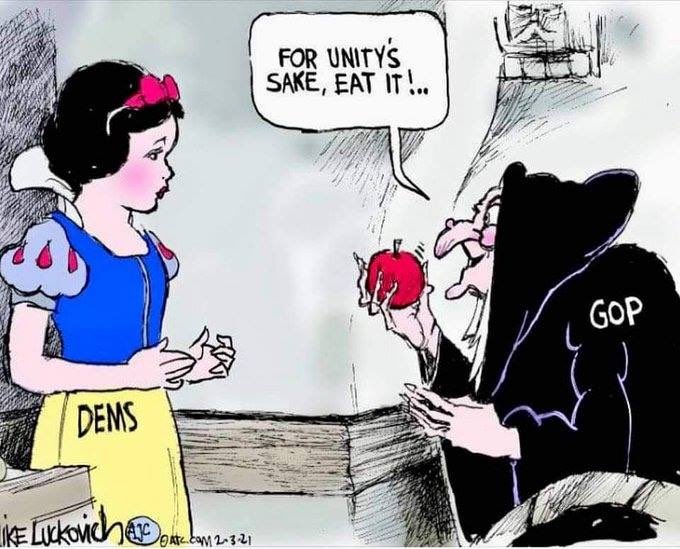
one hand and dispute election and foment sedition on the other. The
party of Trump is a party of opposition to the Six Freedoms, so they
will never be opponents, they will always be enemies. To see them
asking for unity is obviously just maneuvering for political
advantage:
What
to do
As
Anne Applebaum says, in the present time,
“We
have no choice except to coexist. But how? Clearly we need
regulation of social media, but that’s years away. Of course we
need better education, but that doesn’t help us deal with the armed
men who were standing outside the Ohio statehouse this week. Here’s
another idea: Drop the argument and change the subject.”
She says: “Make
the problem narrow, specific, even boring, not existential or
exciting.”
Which
is pretty much what Biden is doing – don't talk theory, just do
practice and see what works out. You can't picture Truman talking
theory, and that is Biden's most familiar precedent. Pursue the
freedoms aggressively, and the view of the desirable future becomes
clearer. The
important thing is delivering services and rights to everyone, show
that all ships can rise at the same time, and not favor just the
Democratic supporters. People who are rising find it harder to
complain about others rising, although they can do it, for sure.
While they are walking this walk, they are also talking the talk, and
calling people to unite on the goals they are expressing.
There
are some things they should be doing with a longer range intention –
to change the atmosphere, to depollute the cultural water we are all
swimming in, we will need some long range projects . These would
include the following:
Civics
teaching. We need massive education and reindoctrination into
our constitution and the theory of the state. That means civics
with 4+ effort. Roadmap
to Educating for American Democracy is a high-profile, well
supported proposal. “A
constitutional democracy requires a citizenry that has a desire to
participate, and an understanding of how to do so constructively, as
well as the knowledge and skills to act for the common good.”
It also means giving people a stake in our government – that
means goodies, green new deal, outdoor work, opportunity plus safety
net.
Personally,
I think the Roadmap is too minimal. A couple of classes aren't going
to do it. We need whole curricula
inculcating civics, starting in middle school, fully represented in
the Department of Education with significant funding, and with
enlightened ideas on learning. In other words, pretty much exactly
what schools don't do now.
National
service would be very supportive of Freedom number five. I'm
always reminded of the rather mindless World War II John Wayne
platoon pictures – “Martinez, you go scout, and Rosenberg, radio
in our position.” Applebaum, advocating the growth of
AmeriCorps: “This might not build eternal friendships, but
seditionists and progressives who worked together at a vaccination
center could conceivably be less likely to use pepper spray on each
other at a demonstration afterward.” Steve Waldman also advocates
persuasively for national service.
Reinforce
norms of truth and honesty – both virtues decimated by the Trump
experience. Other countries expect dishonesty and suffer as a
result. The Greek disaster of eight years ago was on the background
of massive habitual accepted tax evasion. We need to expect the
basic virtues. We can't elect a Senator from Montana who has
roughed up a journalist. We need the expectation of basic standards
of behavior that cannot be legislated.
Call
for generosity of spirit – as Robert Reich observes on Twitter:
Truth v. Lies, Survival v. Suffering, Justice v. Hate, Empathy v.
Cruelty, Democracy v. Fascism – We have to remember that there is
a huge difference between not having enough and having enough, but a
much smaller difference between having enough and having more that
enough. How can you have unity if a prime objective of those with
great resources is to protect and indeed increase those resources,
to the exclusion of sharing with others? Unity can be viewed,
however, as getting together to hash out those issues and go forward
as a functioning polity with some mutual accommodation. It might be
that the holders of the high cards might be brought to feel that the
game is not unidimensional, that they themselves can benefit in a
different way by contributing some of their wealth and advantages.
The church was certainly successful in doing this throughout the
ages, as the wealthy sought to buy holiness. And actually, many are
already so convinced. They are called highly educated liberals.
Pursue
unifying goals that benefit everyone, like climate change, universal
child care, space exploration, bringing up the hindmost, and even
infrastructure.
Summary
Unity
comes and goes. As a country we are sometimes at loggerheads, and
sometime (less often) we find ourselves all pulling the oars in
unison toward an agreed upon goal. It's situational – how intense
are the grievances that tear us apart, and how threatening are the
challenges that force us together? Most of the time we muddle
through, fixing some of the grievances and making the common advances
at the same time. Most of the time we feel that the other side from
us is our opponents, not our enemies, because we basically agree on
the important values of our American life. But sometimes we are way
out on one pole or the other, and then it seems that the other side
is our enemies, that our beliefs and our values are fundamentally
opposed. That's a dangerous time.
It's
important then to look to your basic beliefs and your basic visions.
I think Roosevelt did that with genius when he came up with The Four
Freedoms. This we believe! I think we still believe it today,
although we have new challenges. We also have new basic freedoms
that must be included in our vision. Freedom from Discrimination is
now required. And since the basic element of democracy has been
terribly challenged, we need Freedom of Free and Fair Elections and
Peaceful Transfer of Power. Truly believe in these six, and you can
debate what steps are necessary to achieve them, but you can get to
work. If you have reservations about them, then you cannot be
included in mainstream thought and action, you're too far out.
We
have impediments to unity now – transition to a new mixed ethnic
democracy seems to be the biggest underlying difficulty – but we
have always had them. If you look back on our history, the times
that our society was just sitting around a pool having drinks were
non-existent. We have always struggled.
But
there is every reason for optimism. Our society is getting wealthier
as a whole, our security is getting better, our acceptance of one
another is getting better, we are all getting safer. If we can just
all find our better natures and rise as a whole and be fair to one
another, not give into meanness and hate and feelings of loss of
self-worth, and share better, and keep working hard, then we should
be able to find our way to our ever-present challenges and work and
invent our way out of them, and survive, and be reasonably happy.
Leadership
is important, creativity is important, sensitivity is important, and
clarity of vision is important. These are the arts of collective
living. And you know, it could all work out if we tried a little
harder.
Budd
Shenkin